< Previous | Contents | Next >
I’m writing this introduction in a state of some absence of clarity. Tough luck.
It all started with three teenage boys spending the night in a phone box, smoking cigarettes and talking about girls. Later we would walk five miles down the middle of a dual carriageway to get to the sunrise at 5 a.m. on Brighton promenade, but for now we were each squeezed onto a corner of the concrete floor.
At the time, I certainly didn’t think this was a poetic experience, but it’s become locked into my imagination, a disgusting mix of teenage boy, tobacco, dried urine, chewing gum, and other stains that are best left to your imagination. A layer upon a layer upon a layer upon a layer.
I started writing poetry again in 2014 after an interval of forty-three years. My previous foray as a teenager lasted less than a year, from discovery and praise by a delinquent French teacher (who was later sacked for ultra-left-wing sympathies and an enthusiasm for Messiaen) to ridicule and humiliation by his replacement (a boring scholar of a boring English poet). Mr Humphrey’s attitude was so belittling that I wouldn’t thereafter contemplate any form of creative writing – until half a century later I was able to scrape away his shadow, in some uncanny way, as a result of my illness.
After I was diagnosed with cancer and they got me going on the drugs, I felt a lot better very quickly. Nonetheless, circumstances took over. Collaboration no longer became intrinsic or feasible to my career. Poetry and short stories offered me a liberating, reassuring escapism, as I indulged in my past lives. A feeling of power when, despite what seemed like quite a serious loss in terms of my academic career and my research, I found something else that gave me meaning and a future. The life force that had sustained me up until my diagnosis seemed to lose its potency, but this other thing bubbled up to replace it.
It was segmented off from the real time I lived in. None of my poems concern my children. One concerns Maria. None concern York or (with one exception) opera. Given that by far the most important, worthwhile experiences of my life all occurred from the age of 22 onwards, it’s curious they played no part in my imaginative life. Maybe I don’t want to despoil them, or maybe I fear that those parts of my life
would be a bit boring to a reader. There’s a part of me that always wants to keep bums on seats.
So an awful lot of the poetry and stories that follow are stimulated by my visceral, personal, snotty, bloody, pissy, sicky sense of time that’s passed. A kind of nostalgia. Hopefully not the cuddly, cosy, pots-of-tea-in-the-Blitz kind of nostalgia – that would be the generation before mine. But, weirdly, bluebirds over the white cliffs of Dover have somehow leaked into a lot of the sentiment expressed in these poems.
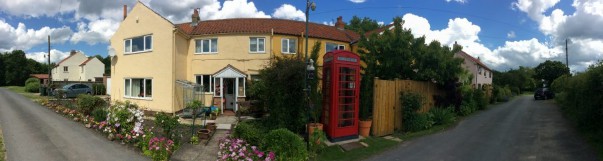
Of course, I know why. Ten years ago, in July 2015, I bought a 1937 K6 telephone box, and then constructed a story that this box had been used during the Blitz to shelter my mother and father from the stuttering of the shrapnel, which would fall from the sky and then clang onto the metal rooves of buildings. And from this scant skeleton emerged a flesh-formed fantasy of my mum, my dad, my family, and me. This powered probably the first five years of writing poems and stories. A great bath of made-up nostalgia.
As for the method – well, there wasn’t really one. I found the poetry easy. (Probably too easy. Probably you can tell I found it too easy.) I tended not to go back over anything or make revisions, or even in some cases critical corrections. So often by the time I’d finished the first draft, I’d had enough and wanted to move onto a different poem. What followed was settling scores with teachers at school, anger distributed quite randomly at figures from the past, that nostalgia (particularly for my mother and various pets we had owned), and amidst this debris were some genuine thoughts and some genuine moments that, to me at least, looked a bit like poetry.
I would typically write poems in the afternoon, sprawled in suitably nineteenth-century poetic style across a sofa, when my brain felt a little bit weary – too weary
to do anything truly constructive, but loose and volatile enough to come up with something fairly spontaneously. Spontaneity was critical. In other words, I might dwell on a topic for a minute or two, and if nothing bounced back then I’d move on
to a different topic. I was using an iPad to do the writing, which allowed for structural revisions as I went along. I very rarely made substantial revisions once I had written my last line. I was too lazy. By then I might have written three or four poems in the space of ninety minutes, and it was time for a cup of tea.
Until the nostalgia-bath was empty. Then I moved on.
The style of writing changed. Partly intuitively, but largely because I listened to my children, who rightly craved simplicity and clarity, or more of it than I was providing. Back I went to Bom the Little Toy Drummer, and out popped some naïve stripped-down ditties, the Teddy poems being the most obvious example. I consciously sought to simplify my language and to speak more directly. And some of these experiments in obviousness – to the point of painfulness – worked quite well.
Do I regret having changed tack and having looked back on some of my verbose nonsense with embarrassment? I think I do now. Because only recently have I been forced to re-read it, it having remained uncorrected and unseen for many years. And despite most of it being dross, I point to the Odysseus poem as being good. So good
I could never do it again. It’s too hard.
So with regret and no regret, I have so enjoyed inhabiting my other self, the one that never was to be, never could be, but would’ve been fun to experience, called Tuffin.
(As ever, I’ve goofed up the timeline. I suggested that these gear changes happened sequentially over a number of years, but in fact the seeds of Tuffin were early sown, and Odysseus still hangs around, particularly when I’m feeling operatic.)
So what should you expect if you can be bothered to read these poems and stories? One: very inconsistent quality. This is not a collection of finely wrought, considered, and edited fragments of a rich creative life. They are often random ramblings, hence the original name ‘Fleeting’, that sprang to mind and to page almost simultaneously, without reflection. Please do not assume that I assume them to be good. I know some of them are terrible. ‘Panettone Cat’ is a good example of this. But I have enjoyed leaving the good and the bad to fight it out for page presence.
Two: lack of structure. I knew I never wanted to order these poems and stories or edit them by my current determination of quality. But the option for ordering by theme was always there. At first, I was sceptical about the merit of keeping them in chronological order. I thought it would expose the fact that the early ones were less good than the later ones. When it came to rereading the poetry, ten years after I’d started, this didn’t seem to be the case.
Sadly, as a poet and a short story writer,
I hadn’t got better; I had just changed. So, I’ve kept it all in chronological order, where you can perhaps chart unbridled bitterness at some of my schoolboy experiences evolving into prepubescent romantic encounters evolving into violent anarchic teenage angst (which I personally grow a little tired of) evolving into Tuffin.
Three: by the time you read this, we may have removed the copy-and-paste idiot errors: paragraphs duplicated, or bits from one poem leaking into another. But they add a certain spice, so we may have left them.
Four: there are themes, but I am not that interested in what they might be, with the exception of there’s Tuffin or not Tuffin.
Five: punctuation was of scant interest to me, and I acquired the arrogance to believe that the reader should punctuate it for themselves. But then on reading it back myself I realised how difficult that was and consequently, you may find yourself in a fog-bound motorway heading God knows where for part of your journey.
Finally, writing this stuff became critical to my sense of well-being while being very ill. That was and remains the biggest contribution that any of these words have to offer. They made me feel good, even the terrible ones. Even the limp rhymes. Even the rekindling of teenage angst. Even the embarrassingly near-the-knuckle descriptions of sex and slimy things. So to hell with it – I enjoyed it.
2014